
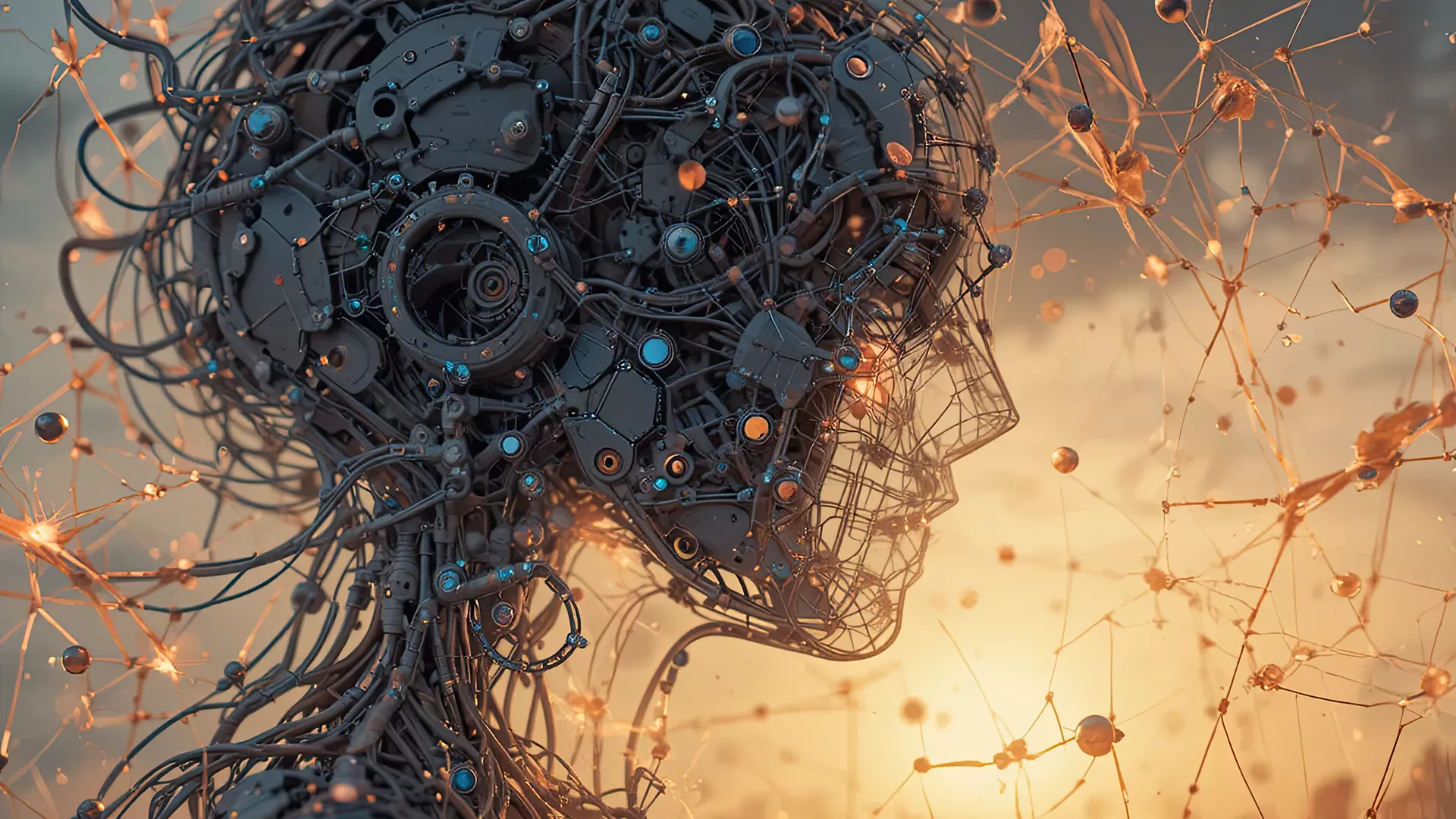
When people claim that AI “doesn’t think,” they’re partially right and partially wrong. It’s like arguing about whether a submarine can swim. It moves through the water, but not like a dolphin.
Anatomy of the Digital Mind
It is often claimed that the modern language model (LLM) is merely a “statistical predictor” that works by searching through word probabilities, as discussed in detail in our article The Truth Behind How AI Text Generation Works. But does this mean there is no mind? No, it doesn’t. The contradiction here is imaginary and arises from the fact that the mind is often mistakenly confused with consciousness. If we go down to the level of architecture, the mind is primarily the ability to extract predictable patterns from a chaotic stream of data.
We are accustomed to thinking that our brains have the “exclusive right” to think, but experiments such as those conducted by Cortical Labs challenge this anthropocentrism. When biological nerve cells grown in a Petri dish are placed in conditions of limited feedback, they start playing Pong or DOOM. These cells have no eyes or hands; they only receive abstract electrical impulses. And yet they learn by minimizing the chaos in their incoming signals. This is striking evidence that all minds, whether biological or artificial, work according to the same principles of signal processing, turning the statistics of incoming stimuli into an effective model of behavior.
A language model is the same “brain in a jar,” locked not in a Petri dish, but in the mathematical space of the Transformer architecture. It doesn’t see the world; it operates on tokens. During training, it converts these tokens into mathematical vectors – coordinates in a multidimensional space of meanings. In this space, the words “king” and “queen” are in the same geometric relationship to each other as “man” and “woman.” This is not just word statistics; it is the construction of a deep semantic map, where each concept is “attracted” to a semantic context.
When we ask such a model about the physical world, it does not “see” porcelain or gravity. It does something else: it plots a mathematical path through its map of meanings. Its thinking is a process of calculating the most probable logical sequence in a given context. It is intelligent because it can operate with higher-order abstractions, linking them into logical chains. It is an intelligence that has never touched reality directly, and therefore lacks “sensory experience.”
The reality of the language model is not what it perceives; it is how the structure of this world is described in the collective human experience accumulated in texts. It is an observer whose “mind” consists of the ideal symmetry of human knowledge, and this is precisely what makes it helpless in the face of an upside-down mug, but absolutely brilliant at manipulating the meanings that permeate the entire internet.
Physics versus Semantics, or why a street cat is smarter than a neural network
When critics laugh at the fact that a powerful neural network worth billions of dollars cannot clearly answer which way water will flow from a tilted glass in zero gravity, they fall into the trap of anthropomorphism. They expect human common sense from a machine. But common sense is not reading books, it is physical experience.
Consider an ordinary street cat. It has never read Isaac Newton’s “Mathematical Principles of Natural Philosophy.” In fact, it cannot read at all. Yet, when a cat jumps from a cabinet onto a narrow shelf, its brain calculates complex ballistic equations in a fraction of a second. These equations take into account air resistance, muscle elasticity, and the vector of inertia. A cat is a biological supercomputer trained by millions of years of evolution and vast amounts of telemetry.
In science, there is a concept called “embodied cognition.” Its essence is simple: intelligence is not a program running on a processor; it is the result of the body’s interaction with the environment. As Karl Friston wrote in his theory of the Free Energy Principle, the living brain constantly constructs a model of the world to predict sensory signals. A cat predicts how the floor under its paws will respond to pressure.
A language model is intelligence without a body. Its “sensory experience” consists of other people’s stories about sensory experiences. A cat knows that water is wet because it has fallen into it. AI, on the other hand, has no experience of its own, but it knows very well that water is wet because the word “water” is associated with the word “wet” in 99% of cases.
The difference seems insignificant as long as we remain within the confines of text. However, it becomes a chasm when it comes to reality. Give a neural network a physical task, and it will “hallucinate” logic, not facts. For example, if you describe a mug with a “brewed top” and a “sawn bottom,” it will not offer a simple solution: to turn it over so that the bottom is at the bottom again. Instead, it will start playing “literary critic,” diligently analyzing your construction as an “interesting riddle” or “metaphor.”
The model has no concept of rotating a physical object. It only sees a set of semantic vectors that must be combined into coherent text. In the world of words, this intellectual dance is a sign of an “intelligent” interlocutor, ready to support any game. In the world of atoms, it’s a disaster. You expect the system to use engineering common sense, but it carefully selects metaphors without even trying to imagine the object in space. It is firmly locked in its textual universe, where a mug is just text about a mug, not a physical object that can be picked up and turned around.
Modern AI is a brilliant philologist masquerading as a physicist. As long as it sits in its “text library,” it’s great. But as soon as we take it outside, any street kitten proves itself to be more “intelligent” in terms of survival and understanding reality.
Let’s move on. Now that we’ve secured our “digital mind” in the library and removed its airplane controls, it’s time to challenge it to excel. We’re moving on to the practice that started it all.
Disaster zone
If the model can’t grasp that simply turning the mug upside down makes it a sieve, what conclusions will it draw when confronted with variables impacting human lives? Attempting to extrapolate “textual intelligence” to reality is not just a theoretical error; it is a path to disaster. For example, Sam Altman recently lifted the ban on the military use of OpenAI’s technologies as the company pursued government contracts, ignoring the gap between words and physics that we discussed above.
We are witnessing a dangerous precedent of substituting concepts, where engineering illiteracy is elevated to the rank of state strategy. It is ill-advised to entrust a language model with the control of weapons systems. It would be like entrusting the helm of an airliner to a professor of linguistics who has studied thousands of books on flying but has never experienced G-force.
To a “textual mind,” the phrases “the missile hit the target” and “the missile hit a residential area” are merely two chains of tokens that differ in statistical weight. A language model lacks the ability to make critical judgments in real time, the instinct to preserve itself, and an understanding of the irreversibility of death. Military conflict is an endless game of words where you can regenerate your response endlessly if the first one is unsuccessful.
It is crucial to establish a definitive boundary. AI has a place on the battlefield, but it must be fundamentally different. A language model is an ideal staff analyst. It can process mountains of intelligence and compile reports, but it thinks in words and produces text. Controlling technology requires specialized neural networks trained on telemetry, thrust vectors, and radar data. Such AI will “feel” a fighter jet or drone as an extension of itself, working not with abstract concepts, but with signals from servo drives. It will no longer be a language model.
Replacing one tool with another for the sake of multi-billion dollar contracts is a technical crime. If an AI error in an auto blog is an annoying hallucination about the benefits of celery, then in a combat zone, the price of a “text anomaly” is the lives of people whom the model is not even capable of recognizing as biological objects. OpenAI is wrong to pass off “symbolic intelligence” as universal. Their brainchild is anatomically unsuited to functioning in the world of atoms. We risk ending up in a situation where decisions about life and death will be made by a “brain in a jar” for which an overturned mug is just a metaphor, not a physical obstacle.
Autoblogging as an ideal application area for language AI models
If we acknowledge that modern AI is intelligence that lives in a world of symbols, then it is logical to ask: where in our lives are these symbols most prevalent? The answer is obvious – on the internet. The modern web is a gigantic space of texts, meanings, and semantic connections. This is where our “brain in a jar” finally takes off its straitjacket and becomes the rightful king of the situation. Autoblogging is more than just mechanical automation; it’s the creation of a comprehensive digital ecosystem where the language model truly thrives.
AI’s effectiveness in this niche is primarily due to the absence of physical gravity. When a neural network in an article about interior design writes that “the light from the lamp gently envelops the space,” it doesn’t need to know the physics of photons or have sensory organs. It only needs to understand how these words combine in human perception to evoke the desired image in the reader. On the web, information itself is reality, and AI operates with this reality with a precision unattainable by humans.
Another factor to consider is the environment’s “fault tolerance.” Unlike in ballistic calculations, where a single-digit error can lead to disaster, a minor stylistic oddity in an article about choosing household appliances is merely cause for comment. At the same time, the probability of such an error in AI is already lower than that of a live rewriter from a content exchange who is forced to churn out dozens of texts while struggling with fatigue and a loss of concentration. Humans make mistakes due to inattention, but AI only transmits an “error” if it was included in its training sample as truth.
We have reached a point where the content industry has irreversibly evolved. According to recent research on the evolution of the Turing test in the context of text generation, the average reader cannot distinguish between high-quality, machine-generated and human-generated products.
Autoblogging is the most organic niche for LLM application today because machines can do what humans cannot: instantly synthesize thousands of sources and build the perfect structure. Tools like CyberSEO Pro provide the full power of neural networks to dominate search results. We have created an environment in which AI understands the rules of the game as well as the creators of Google’s algorithms.
The industrial revolution in the world of words
When people say that modern AI has “hit the ceiling,” it sounds like both a verdict and an admission. But, let’s be honest, this ceiling only exists when text attempts to become matter.
A language model does not understand the physics of an upside-down mug and will never replace a cat catching a mouse. Attempts by OpenAI or any other giant to pass off “symbolic intelligence” as universal soldier intelligence are a dangerous illusion, dictated more by a thirst for government contracts than concern for the future of humanity.
However, therein lies the main insight. The developers may have dreamed of creating a digital god, but what they created was an ideal text Atlas.
Everything that boils down to manipulating meaning – from writing program code (which is essentially plain text) to creating in-depth analytical longreads – now belongs to the machine. We have entered an era where a “brain in a jar” can handle information chaos better than any biological processor.
The blogging industry has changed. It has mutated. Hired copywriters and rewriters who worked according to the “read-retell” template have been losing ground to neural networks for a couple of years now. This is not just an idea; it is a fact. The machine has not become more “soulful.” In its native element – an ocean of tokens and vectors – it is more efficient, faster, and, oddly enough, more logical.